LMS
LMS
Last updated on 16th May 2026| 4570

- Introduction to Generative AI Tutorial
- Foundations of AI & ML
- Core Generative Models
- Text Generation
- Image Generation
- Audio & Speech Generation
- Video Generation
- Advanced Architectures
- Applications of Generative AI
- Ethics and Responsible AI
Introduction to Generative AI Tutorial
Generative AI is a branch of artificial intelligence that creates new content such as text, images, audio, video, and code by learning patterns from large datasets. Unlike traditional predictive AI, which focuses on classification or forecasting, generative AI produces original outputs that closely resemble human-created content using advanced deep learning techniques and transformer-based architectures. Models such as GPT, diffusion models, and other foundation models are widely used for content creation, virtual assistants, software development, design, and business automation. To gain practical knowledge and hands-on experience, explore the Gen AI Course. Today, generative AI is transforming industries including healthcare, finance, education, entertainment, marketing, and software engineering by improving productivity, fostering creativity, and enabling intelligent automation. Learning generative AI provides beginners with a strong foundation for building real-world AI applications while understanding important concepts such as prompt engineering, ethical AI, model evaluation, and responsible AI development.
Foundations of AI & ML
- Core Concepts: Artificial Intelligence (AI) enables machines to simulate human intelligence, while Machine Learning (ML) allows systems to learn from data and improve performance without explicit programming. Deep learning, Natural Language Processing (NLP), and computer vision are key AI domains that power modern intelligent applications.
- Learning Path: Begin with mathematics, including probability, statistics, and linear algebra, followed by Python programming and machine learning fundamentals. Learn supervised, unsupervised, and reinforcement learning through practical projects and strengthen your understanding with the Generative AI Step-by-Step Tutorial.
- Evolution of AI: Artificial Intelligence has evolved from rule-based expert systems to machine learning, deep learning, and transformer-based architectures. Modern AI powers search engines, recommendation systems, robotics, autonomous vehicles, speech recognition, and generative AI applications.
- Applications: AI is widely used in healthcare for disease diagnosis, finance for fraud detection and risk analysis, retail for personalized recommendations, manufacturing for predictive maintenance, and logistics for route optimization and demand forecasting.
- Importance for Freshers: Learning AI and ML builds a strong technical foundation, improves analytical and problem-solving skills, prepares beginners for internships and real-world projects, and creates career opportunities in artificial intelligence, machine learning, data science, and generative AI.
Ready to earn your Gen AI Professional Certification? Discover the Gen AI Course now available at ACTE!
Core Generative Models
Core generative models are designed to learn the underlying patterns and probability distributions of data so they can generate new, realistic content such as text, images, audio, and video. Unlike discriminative models that focus on classification or prediction, generative models create original outputs by learning latent representations and hidden relationships within datasets. Popular generative architectures include Variational Autoencoders (VAEs), Generative Adversarial Networks (GANs), diffusion models, and transformer-based models, each serving different AI applications. To gain practical experience with these technologies, enroll in the Gen AI Course. Understanding these foundational models helps beginners build expertise in deep learning, computer vision, natural language processing, and modern generative AI development.
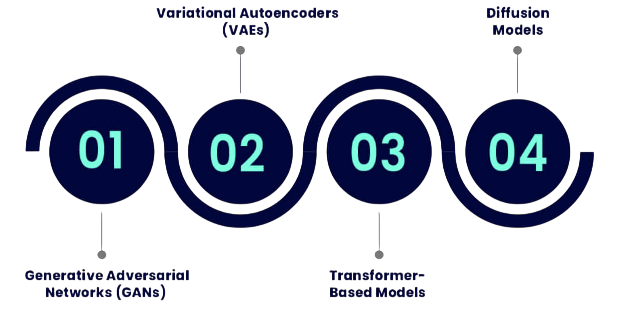
They are widely used in text generation, image synthesis, and drug discovery. For freshers, the key idea is that generative models balance creativity with constraints to ensure meaningful outputs. Understanding them requires knowledge of probability distributions and optimization, making them central to modern AI applications.
Get Your Gen AI Certification by Learning from Industry-Leading Experts and Advancing Your Career with ACTE’s Gen AI Course.
Image Generation
Image generation is one of the most innovative applications of generative AI, enabling machines to create realistic, artistic, and synthetic visuals from text prompts or existing images. Technologies such as Generative Adversarial Networks (GANs), Variational Autoencoders (VAEs), and diffusion models are widely used to generate high-quality images for creative and business applications. GANs produce images through adversarial learning between a generator and a discriminator, while diffusion models generate detailed visuals by gradually removing noise from random data. Beginners can build hands-on projects using simple image datasets before progressing to advanced text-to-image generation models. To explore AI-powered assistants and modern generative technologies, visit the Google Gemini Tutorial for Beginners. Image generation is widely used in digital art, product design, gaming, animation, advertising, healthcare, and synthetic data creation. Learning these techniques helps beginners develop practical skills in deep learning, computer vision, and generative AI while preparing them for real-world AI development and creative technology careers.
Text Generation
- Definition: Text generation uses Large Language Models (LLMs) to understand context and predict the next words in a sequence, enabling the creation of human-like content such as articles, emails, reports, code, stories, and conversational responses.
- Techniques: Effective text generation involves using transformer-based models such as GPT, applying prompt engineering, fine-tuning models for domain-specific tasks, optimizing prompts, and evaluating generated content for accuracy, relevance, and coherence.
- Applications: Text generation powers AI chatbots, virtual assistants, document summarization, language translation, content creation, coding assistants, question-answering systems, and customer support automation. Learn more through the Claude Tutorial for Beginners.
- Challenges: Common challenges include hallucinations, biased outputs, factual inaccuracies, high computational costs, prompt sensitivity, and maintaining consistency, making responsible AI practices and continuous evaluation essential.
- Learning Path: Begin with simple prompts, experiment with pre-trained LLMs, build projects such as chatbots and text summarizers, practice prompt engineering, evaluate model outputs, and document your work to develop practical skills in generative AI.

Audio & Speech Generation
- Definition: Audio generation creates sounds, while speech generation mimics voices. Models learn waveforms to produce music or speech outputs.
- Techniques: Use RNNs and transformers, apply spectrograms, fine-tune voice models, and evaluate clarity to improve realism.and Know More About in Gen AI Engineer Internship Tutorial For Freshers
- Applications: Virtual assistants, music composition, audiobook narration, and accessibility tools highlight the utility of audio generation.
- Challenges: Risks include synthetic misuse, resource costs, quality issues, and bias in voices. Awareness and mitigation are essential.
- Learning Path: Start with small datasets, build voice clones, experiment with music, document findings, and share projects to gain confidence.
Video Generation
Video generation is an advanced area of generative AI that combines text, image, and audio synthesis. Models create dynamic sequences that resemble real or animated videos. For freshers, this field is challenging but rewarding, as it requires integrating multiple modalities. Applications include entertainment, advertising, and education. Video generation can automate content creation, reducing production costs and AI Image Generation Tutorial For Freshers. It also supports simulations in science and training. Challenges include high computational demands and ethical concerns about deepfakes. Despite these issues, video generation is rapidly evolving with diffusion and transformer-based models. Beginners can start with short clips or animations before tackling complex projects. Video generation demonstrates the full potential of AI & ML, blending creativity, storytelling, and technical expertise into one domain.

Get JOB Oriented Gen AI Training for Beginners By MNC Experts
- Instructor-led Sessions
- Real-life Case Studies
- Assignments
Want to Master Gen AI? Explore the Gen AI Master Program Offered at ACTE Today!
Applications of Generative AI
Generative AI has revolutionized applications across industries. In business, it powers customer support chatbots and automates marketing content creation. In education, it generates personalized tutoring materials and adaptive learning systems that respond to student needs. Healthcare leverages generative AI for synthetic medical data, drug discovery, and diagnostic support in Gen AI Course. Entertainment thrives on AI-generated art, music, and video, opening new creative possibilities. Generative AI also supports accessibility by producing alt-text visuals and speech synthesis for differently-abled users. In logistics, predictive modeling enhances supply chain efficiency.
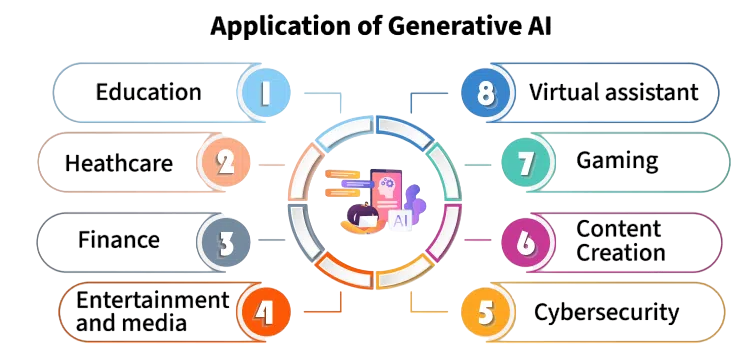
Finance uses generative AI for fraud detection and risk modeling. Research benefits from synthetic datasets that accelerate experimentation. Even creative industries like fashion and design are transformed by AI-driven prototypes. These diverse applications highlight the versatility and impact of generative AI in shaping modern innovation.
Want to Learn About AI? Explore Our DevOps Interview Questions and Answers Featuring the Most Frequently Asked Questions in Job Interviews.
Advanced Architectures
- Transformers: Use self-attention to handle sequences, power LLMs, and enable scalability. Transformers dominate modern AI, and freshers must study them to understand advanced text and multimodal systems.
- GAN Variants: Conditional GANs, StyleGAN for art, and CycleGAN for transfer expand the scope of generative AI. These variants inspire applications in design, image translation, and creative industries.
- VAEs: Encode latent space and decode outputs to balance accuracy with flexibility. VAEs support structured data and versatile applications, making them essential for freshers to explore.
- Diffusion Models: Reverse noise step by step to generate realistic outputs. They dominate text-to-image systems and are powerful tools for Beginner Gen AI Projects Tutorial to gain skill in modern generative AI.
- Hybrid Models: Combine architectures to improve performance, handle multimodal tasks, and expand creativity. Hybrids show innovation and give freshers insight into cutting-edge AI research.
Ethics and Responsible AI
Generative AI has revolutionized applications across industries. In business, it powers customer support chatbots and automates marketing content creation. In education, it generates personalized tutoring materials and adaptive learning systems that respond to student needs. Healthcare leverages generative AI for synthetic medical data, drug discovery, and diagnostic support. Entertainment thrives on AI-generated art, music, and video, opening new creative possibilities Gen AI Course. Generative AI also supports accessibility by producing alt-text visuals and speech synthesis for differently-abled users. In logistics, predictive modeling enhances supply chain efficiency. Finance uses generative AI for fraud detection and risk modeling. Research benefits from synthetic datasets that accelerate experimentation. Even creative industries like fashion and design are transformed by AI-driven prototypes. These diverse applications highlight the versatility and impact of generative AI in shaping modern innovation.